

After the Crowd Leaves: How London 2012 Set the Stage for Legacy Portfolios and Modeled the Future of Mega-events
Mega-events are often remembered through their most visible images: the opening ceremony, the architecture, the arrival of the world, the crowds, the athletes, the flags, the final spectacle of a city temporarily transformed. But the more revealing story begins underneath the ceremony. It begins with the capital plan.
Behind every Olympic Games, World Cup, Biennial, or major public-facing program is a portfolio of decisions: what gets funded, what gets built, who benefits, who is displaced, whether temporarily or permanently, what becomes apparent, what becomes waste, and what remains useful after the world leaves, determines the legacy.
That was the central topic of my presentation: optimizing capital project portfolio prioritization to maximize value, strategic alignment, and long-term impact, and how the Positive Legacy Model established by the London 2012 Olympics influenced major public-facing events can optimize capital project portfolio prioritization by aligning funding, infrastructure, governance, and legacy before delivery begins.
The surprising outcome of the discussion is that legacy is not the soft side of capital planning. Legacy is one of the most practical ways to prevent capital waste.
London 2012 treated the Olympics not simply as a sporting event, but as a fixed-deadline capital delivery program. The Games concentrated investment into East London and used the pressure of a global deadline to accelerate regeneration, infrastructure, mobility, public realm, and long-term asset planning. In this sense, London 2012 became a concentrated legacy model: one geography, one deadline, one delivery authority, and one long-term regeneration ambition.
The financial impact gives the model its sharper meaning. The program’s total cost was roughly £8.77 billion to £9.3 billion, above the original estimate, but the public sector funding package was still delivered £377 million below budget. Major events held at Queen Elizabeth Olympic Park later generated more than £130 million in capital within six years, while the UK government reached an £11 billion trade and investment target within 14 months of the Games, projected to generate up to £41 billion in gross value added (GVA) by 2020.
While London 2012 exceeded its original bid estimate, the formal public sector funding package was managed below its revised budget through centralized governance, disciplined cost control, contingency management, and Olympic Delivery Authority (ODA)-led delivery oversight. The post-Games financial legacy was then tracked separately through economic impact reporting, including revenue generated by major events at Queen Elizabeth Olympic Park, UKTI-measured trade and investment activity, and projected long-term GVA benefits. In this sense, London 2012 did not simply “come under budget”; it created a framework for measuring how capital investment could continue producing value after delivery.
Those numbers matter because they show how a capital portfolio can outlive its initial purpose. The return was not only in the venues delivered. It was in asset reuse, place regeneration, continued programming, attracting investment, strengthening public image, and creating a framework other city-wide mega-events could study.
The London 2012 CAPEX model also tells a revealing story. Its anticipated ODA final cost of approximately £6.711 billion included £1.826 billion for site preparation and infrastructure, £1.104 billion for venues, £816 million for transport, £1.020 billion for East Village, and additional investment in park-wide projects, media facilities, program delivery, tax, interest, and contingency. This breakdown shows the Games weren't only funding sport. They were funding land, access, housing, movement, visibility, and post-event use.
That is the difference between spectacle and strategy.
A stadium can become a public asset, or a liability. A village can become housing, or it can become an empty, outsourced infrastructure. A transport upgrade can improve mobility, or it can serve a temporary crowd and disappear from public value. That difference is determined early, in the capital portfolio, before construction begins.
That is why the failures of other Olympic programs still matter. Athens 2004 is often remembered as a cautionary tale not because the Games failed as a public spectacle, but because the capital portfolio lacked a convincing afterlife. Too many venues were built or upgraded for Olympic use without sufficient demand, accessibility, governance, or long-term operating plans to keep them active after the event. The result was a legacy burden: specialized infrastructure that became costly to maintain, difficult to repurpose, and increasingly disconnected from everyday public value. For future mega-events, Athens shows that CAPEX failure is not only overspending; it is investing in assets without a durable purpose beyond the closing ceremony.
Brazil’s Rio 2016 Olympics offers another cautionary lesson. Rio carried ambitious legacy promises, including transport improvements, venue transformation, and broader urban redevelopment. Later assessments have described a gap between Rio’s sustainability and legacy aspirations and the realities of implementation. Transport research also found that infrastructure expansion alone was not enough to close accessibility gaps, with benefits unevenly distributed across income groups and parts of the city.
This is the harsh truth of mega-event capital planning: poor legacy design does not only waste money. It can produce inaccessible infrastructure, underused venues, public maintenance burdens, and symbolic promises that never fully reach the communities they were meant to serve.
London 2012 was not perfect. Its regeneration story also carried critique. The Olympic Park wards saw only a slight, short-lived boost in property values and sales, while patterns of gentrification and migration raised questions about whether local communities were the true beneficiaries of the promised urban transformation. Real estate values rose, pushing local communities into unaffordable housing. That tension matters. It reminds us to measure long-term impact, not assume it.
But London 2012 remains useful because it turned delivery knowledge into a transferable framework. The Olympic Delivery Authority’s Learning Legacy captured lessons in governance, procurement, risk, sustainability, safety, and long-term asset use so future major projects could avoid repeating mistakes and improve delivery standards. The Learning Legacy was organized around areas including health and safety, sustainability, procurement, transport, project management, design, engineering, equality, employment, skills, and planning. (GOV.UK)
Safety is especially important here. It is often treated as an operational requirement, but in major capital programs, safety is a strategic value indicator. London 2012’s construction program became known for its health and safety performance, with the ODA reporting no work-related fatalities across the construction program. (GOV.UK) That outcome did not happen by accident. It reflected governance, reporting, workforce culture, supplier coordination, risk controls, and accountability. In other words, safety was part of the capital delivery model.
The same principle applies to public safety and security during the event itself. For FIFA 2026, the distributed portfolio model brings a different risk profile. Instead of one Olympic Park, the tournament spans multiple countries, host cities, stadiums, transportation systems, safety and security plans, hospitality networks, sustainability commitments, and public-facing investments. Security and crowd control must therefore be managed across multiple jurisdictions and host-city delivery structures, making public safety part of the portfolio rather than a separate operational layer.
FIFA’s own 2026 planning also places sustainability and human rights within the tournament framework, requiring host cities to develop human rights action plans with local stakeholders and community groups. (FIFA Clearinghouse) Houston’s 2026 Human Rights Plan, for example, includes public safety awareness around worker rights, personal safety, harassment prevention, gender-based violence, accessibility, safeguarding, security, and policing. (FIFA 2026 Houston) This expands the definition of legacy from buildings and transport into workforce protection, public trust, accessibility, and safe participation.
That is where the comparison between London 2012 and FIFA 2026 becomes most useful.
London 2012 was a concentrated legacy model. FIFA 2026 is a distributed capital portfolio model. London concentrated capital into East London through one major geography and one major delivery authority. FIFA 2026 spreads delivery across three countries, 16 host cities, stadiums, mobility systems, security networks, hospitality operations, and public-facing local economies.
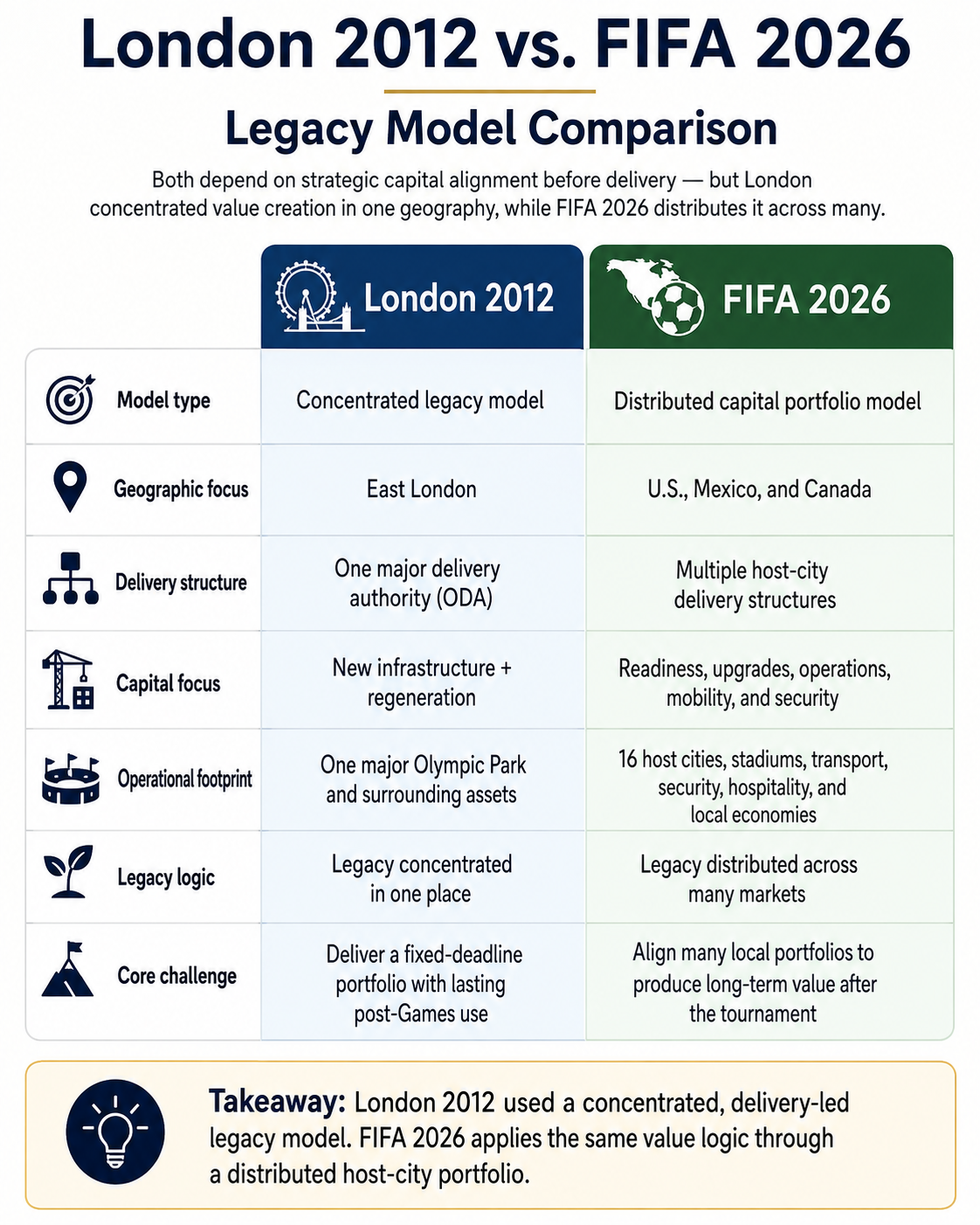
Legacy models compared: concentrated capital, distributed impact.
The core discipline, however, remains the same: to align strategic investment and capital before delivery.
London shows how concentrated CAPEX can create long-term value when the portfolio is designed with legacy from the start. FIFA 2026 tests whether the same principle can work across many host-city portfolios, where each city must prove strategic return, public value, CAPEX efficiency, safety readiness, accessibility, and long-term benefit after the tournament ends.
The FIFA 2026 financial model makes that challenge even more visible. The tournament budget is approximately $3.76 billion for competition organization, prize money, and operational expenses, with record revenues projected to exceed $11 billion for the 2023–2026 cycle. The operating budget was reportedly reduced by more than $100 million, with roughly $1.12 billion in operating costs covering technical services, transport, and security.
This is where CAPEX efficiency requires careful understanding. Efficiency is not simply cutting budgets. It is protecting the relationship between cost, risk, use, safety, access, public value, and long-term return. A reduced operating budget may look efficient on paper, but the true measure is whether host cities can still deliver secure, accessible, well-governed, and publicly beneficial event systems.
Another key success of London 2012 was the cultural programming surrounding the Games. The Olympics were not treated as a purely athletic event, but as a public platform where sport, culture, tourism, civic space, and international collaboration could meet. This mattered because the legacy model was not only about what was built in East London; it was also about inviting people to experience the city as those investments were activated.
The Cultural Olympiad ran as a four-year UK-wide program from 2008 to 2012 and culminated in the London 2012 Festival, which ran from 21 June to 9 September 2012. It featured more than 25,000 artists from all 204 competing Olympic and Paralympic nations, with thousands of events staged across the UK. Government reporting later described the Cultural Olympiad as attracting more than 43 million visitors, participants, audiences, and volunteers, which shows how culture became part of the wider participation and legacy strategy, not an ornamental add-on.
This cultural layer gave London 2012 a more generous public life. It created ways for visitors and local communities to participate in the Games without needing a stadium ticket. Public spaces, museums, theatres, streets, parks, and temporary stages became extensions of the Olympic experience. London City Hall later noted that more than 5,000 free cultural events took place across all 33 London boroughs, spanning music, dance, visual arts, theatre, and fashion.
This matters for capital project portfolio prioritization. Cultural programming helped convert Olympic investment into public engagement, reputational value, tourism activity, and civic participation. It created what infrastructure alone cannot always produce: atmosphere, belonging, memory, and shared ownership. The arts made the Games more porous. They allowed world cultures to collaborate, perform, gather, and be seen in local and public spaces.
This is also where the London model becomes relevant to FIFA 2026. A distributed tournament across the United States, Mexico, and Canada cannot rely only on stadium readiness, transport, security, and hospitality. It also has to ask how each host city will activate its cultural identity around the event. The strongest legacy plans will use sport as the anchor, but culture as the invitation—creating public-facing experiences that let visitors and residents participate in something larger than the match itself.
London 2012 proved that legacy is measured not only by what remains standing, but by what remains felt and experienced outside the sporting events. Its cultural programming showed how sport can open the door, while the arts invite the world in.
This is the larger lesson from London, Athens, Rio, and now FIFA 2026: mega-events do not fail only because they cost too much. They fail when the capital has no future. They fail when assets are inaccessible, safety planning is reactive, public benefit is uneven, venues lose their function, the maintenance burden falls back on the public, and the project’s legacy becomes a story told in the past tense.
The best capital portfolios do the opposite. They measure value through financial, strategic, reputational, safety, accessibility, and long-term impact indicators. They shift capital, talent, and resources toward the programs with the strongest strategic return. They reduce CAPEX inefficiencies by applying fail-fast thinking before waste becomes embedded in the project, and they treat legacy not as a closing statement, but as a design requirement.
London 2012 helped establish a model where legacy was not an afterthought. It was part of the capital strategy from the beginning.
That is the opportunity for future mega-events and complex capital programs: to spend more intelligently, prioritize more intentionally, protect people more deliberately, and design portfolios that do more than deliver assets.
They must create something useful, measurable, accessible, safe, and alive long after the event has left the stage.
Working Bibliography
Presentation Materials
Eltorie, Aïda. Optimize Capital Project Portfolio Prioritization to Maximize Value, Strategic Alignment and Long-Term Impact. Presentation deck, 2026.
Eltorie, Aïda. Presentation Talking Points. Speaker notes, 2026.
Eltorie, Aïda. Plan_Capital Legacy. Working notes, 2026.
London 2012: Delivery, Governance, CAPEX, and Learning Legacy
Major Projects Association. “A Learning Legacy from the London 2012 Construction Programme.” This source supports the discussion of the Olympic Delivery Authority’s Learning Legacy and how London 2012 captured lessons in construction, procurement, sustainability, governance, and project management. (Major Projects Association)
UK Parliament, Hansard. “Government Olympic Executive Quarterly Report.” This source supports the point that the London 2012 public sector funding package was forecast at £8.921 billion, creating a £377 million saving against the £9.298 billion budget. (Hansard)
UK Government. “London 2012 Forecast to Come in Nearly £400 Million Under Budget.” This source supports the reporting around the final quarterly economic report, the £377 million saving, and the transformation work for Olympic Park legacy use. (GOV.UK)
UK Parliament, Hansard. “LOCOG and Public Sector Funding.” This source supports the later updated forecast that projected savings increased from £377 million to £528 million against the public sector funding package. (Hansard)
Olympic Delivery Authority / GOV.UK. “ODA Sets Out Achievements Since 2006.” This source supports the discussion of the ODA’s delivery role, the creation of venues and homes, and the health and safety record, including no work-related fatalities during the construction programme. (GOV.UK)
UK Government. “Learning Legacy’s ‘Goldmine of Knowledge’ Kept by Cabinet Office to Help Other Major Projects.” This source supports the Learning Legacy themes, including health and safety, sustainability, procurement, transport, and project management. (GOV.UK)
UK Government / DEFRA and Olympic Delivery Authority. “London 2012 Legacy: Sustainable Procurement for Construction Projects.” This source supports the article’s discussion of procurement and sustainability as part of London 2012’s capital delivery legacy. (GOV.UK)
Major Projects Association. “London 2012 Post Games Sustainability Report — A Legacy of Change.” This source supports the sustainability and post-Games legacy framing for London 2012. (Major Projects Association)
London 2012: Economic and Cultural Legacy
Queen Elizabeth Olympic Park. “London 2012 Legacy Generates More Than £130 Million for the Capital from Major Sporting Events.” This source supports the claim that major post-Games events generated more than £130 million for London. (Queen Elizabeth Olympic Park)
UK Government. “Turning the Games into Gold: Government Announces Almost £10 Billion Economic Boost from London 2012.” This source supports the UKTI trade and investment legacy target and the Olympic-related business activity connected to exports, inward investment, contracts, trade missions, and Host2Host agreements. (GOV.UK)
UK Government. “Olympic Games Legacy Boosts Economy by Billions.” This source supports the projection that London 2012 could generate up to £41 billion in Gross Value Added by 2020, as well as trade and investment benefits following the Games. (GOV.UK)
UK Government. “2010 to 2015 Government Policy: 2012 Olympic and Paralympic Legacy.” This source supports the broader economic, sporting, and cultural legacy framing of London 2012. (GOV.UK)
UK Government. “London 2012 Festival Line-Up Announced.” This source supports the Cultural Olympiad and London 2012 Festival details, including more than 25,000 artists from all 204 competing Olympic and Paralympic nations. (GOV.UK)
London City Hall. “Culture and 2012 Legacy.” This source supports the cultural programming discussion, including more than 5,000 free cultural events across all 33 London boroughs. (London City Hall)
FIFA 2026: Distributed Portfolio, Sustainability, Human Rights, and Safety
FIFA. “FIFA World Cup 26™ Sustainability & Human Rights Strategy.” This source supports the discussion of FIFA 2026’s sustainability and human rights framework. (Inside FIFA)
FIFA Clearing House. “FIFA World Cup 26™ Sustainability & Human Rights Strategy: Strategy Overview.” This source supports the point that FIFA 2026 aims to promote environmental protection, respect for human rights, and positive legacy across host countries, host cities, and stadiums. (FIFA Clearinghouse)
FIFA Clearing House. “FIFA World Cup 26™ Sustainability & Human Rights Strategy: Introduction.” This source supports the point that host cities engaged local human rights stakeholders and that event planning can affect health, safety, and welfare. (FIFA Clearinghouse)
Centre for Sport and Human Rights. “FIFA’s FWC26 Human Rights Framework: A Shared Platform for Positive Impact.” This source supports the discussion of host-city human rights action plans and stakeholder consultation. (Centre for Sport and Human Rights)
Houston FIFA World Cup 2026 Host Committee. “Human Rights Action Plan.” This source supports the Houston-specific discussion of public safety, worker rights, accessibility, safeguarding, gender-based violence prevention, security, policing, and access to remedy. (FIFA 2026 Houston)
Cautionary Legacy Models: Athens 2004 and Rio 2016
Athens Social Atlas. “Olympic Games 2004.” This source supports the discussion of Athens 2004 as a cautionary legacy case, including oversupply of venues, lack of post-Games utilization strategy, abandoned facilities, and maintenance burdens. (Athens Social Atlas)
Essex, Stephen, and Renata Latuf de Oliveira Sanchez. “The Achievement of Sustainability and Legacies by the Host Cities of the Summer Olympiads, 2012–2024.” Planning Perspectives 39, no. 3 (2024): 595–613. This source supports the comparative discussion of sustainability and legacy approaches across London 2012, Rio 2016, Tokyo 2021, and Paris 2024. (University of Plymouth)
Pereira, Rafael H. M. “Transport Legacy of Mega-Events and the Redistribution of Accessibility to Urban Destinations.” Cities 81 (2018): 45–60. This source supports the discussion of Rio 2016 transport legacy and uneven accessibility benefits across income groups and urban destinations. (ORA)
Urban Demographics. “Transport Legacy of Mega-Events and Inequalities in Access to Opportunities in Rio de Janeiro.” This source supports the broader Rio 2016 discussion around transport legacy, inequality, and access to jobs, schools, and healthcare. (Urban Demographics)
ScienceDirect. “Mega-Event Transport Legacy in a Developing Country: The Case of Rio 2016 Olympic Games and Its Transolímpica BRT Corridor.” This source supports the discussion of Rio’s transport infrastructure and the limitations of event-driven mobility planning. (ScienceDirect)
Supplemental Sources Referenced in Notes
What Works Wellbeing. “Learning Legacy: Applying Lessons from the 2012 Olympics to Major Projects.” This source was referenced in the notes for the Learning Legacy discussion and the value of carrying project knowledge into future major programs.
Crossrail Learning Legacy. “About Learning Legacy.” This source was referenced in the notes as a related model for capturing and transferring major project lessons.
Federal Reserve Economic Data / Bureau of Labor Statistics. Employment data series referenced in the notes for Olympic-related temporary employment comparisons.