

After Restitution: The Politics of Return and the Archive of Absence
After Restitution: The Politics of Return and the Archive of Absence traces the unfinished life of displaced cultural memory through BLACK LAND’s engagement with Kemet, the fertile “Black Land” of ancient Egypt, and the institutions that continue to shape how its histories are seen, heard, and possessed. Moving through Yara Mekawei’s sound performances, which reawaken space and unsettle the enforced silence of the museum; Monica Hanna’s work on Nefertiti, provenance, and decolonized archaeology; Fazil Moradi’s concept of catastrophic art; and Kerylos Aziz’s site-based knowledge of Egypt beyond institutional narratives, the essay reveals restitution as more than the return of an object. It is a poetic and critical inquiry into land, ritual, memory, authority, and the absences that remain when an artifact is removed from the world that once gave it meaning.
There are histories that enter museums through the language of preservation and others that arrive through the concealed routes of extraction. They are carried across borders through archaeological division, imperial expedition, military conquest, private exchange, institutional purchase, and the authority of scholarship to rename what has been displaced. Once inside the museum, the passage is often softened. Removal becomes acquisition, possession becomes stewardship, and a cultural or spiritual entity becomes an object within a collection. The label describes material, date, dynasty, provenance, and dimension, but rarely conveys the social world interrupted by the object’s movement. A figure once approached through ceremony becomes sculpture; a burial becomes a scientific holding; a sacred site is divided into fragments; and a body, separated from name and ritual, becomes an inventory number. The modern museum is able to preserve matter with extraordinary precision, yet it cannot necessarily preserve the relationships that once gave that matter meaning.
The Berlin-based initiative BLACK LAND e.V. begins within this fracture. Through sound, performance, curatorial research, historical inquiry, scenography, public discussion, and ritual-based experimentation, BLACK LAND approaches ancient Egyptian cultural entities not as finished remains of a distant civilization but as active presences whose displacement continues to shape the present. Its work asks what happens when artifacts are removed from the landscapes, communities, cosmologies, and systems of knowledge through which they were once understood. It also asks what happens when the institutions responsible for such separation become the principal authorities entrusted to explain it. BLACK LAND’s work is therefore not only concerned with the fate of objects. It examines the architecture of interpretation surrounding them: who names, who possesses, who studies, who is granted access, and who is expected to accept the museum’s account of history as complete.
The name BLACK LAND recalls Kemet, the fertile dark earth of the Nile, while its relation to the Red Land evokes the desert beyond it: a terrain of danger, sacred force, heat, transformation, and uncertainty. This relationship offers more than a historical reference. It mirrors the intellectual and artistic space in which the initiative operates, moving between what has survived materially and what has become difficult to recover. A museum may retain the stone of a statue while losing the gestures once performed before it. It may preserve inscriptions while neglecting the relationship between those inscriptions and the architecture, geography, climate, and ritual rhythm surrounding them. It may record an excavation site while treating the land as little more than the point from which an object departed. The artifact remains visible, but the world that made it intelligible is gradually made invisible.
This problem is increasingly central to contemporary debates about art criticism and eco-socially engaged practice. Since the early 2000s, artistic engagement has expanded across questions of social justice, environmental destruction, displacement, institutional accountability, and political responsibility. Yet criticism has not always evolved at the same pace. Traditional art writing often privileges the autonomous artwork, the singular artist, and the formal language of the exhibition. Eco-socially engaged practices demand something more relational. They require criticism to account for land, labor, memory, ecology, historical violence, public life, and institutional power as interconnected rather than supplementary conditions. In this context, BLACK LAND offers not only an artistic project but a model for how criticism might become more responsive to the social and ecological worlds surrounding the work.
The initiative’s 2023 festival, BLACK LAND, RED LAND—RESTITUTE, examined the knowledge systems and operational structures through which European museums have transformed displaced cultural and spiritual entities into holdings, collections, and institutional capital. Through artistic and discursive events across Berlin, the festival considered how imperial expeditions and colonial forms of research participated in the appropriation of artifacts, religious materials, architectural fragments, and human remains. It also addressed how European museums positioned themselves as universal stewards of cultural heritage while large parts of the communities from which such materials originated remained unable to access or interpret them on equal terms. The contradiction is fundamental: the museum speaks in the name of humanity while controlling which histories may be told, who may tell them, and under what institutional conditions they may become legitimate.
To write critically about such work requires more than an assessment of curatorial coherence or artistic effectiveness. It requires attention to the systems of separation that made the project necessary. Eco-social criticism cannot treat the museum as a neutral container, nor can it regard ecological and social questions as themes placed around an artwork. The museum itself is part of the social ecology under examination. It shapes relations between objects and audiences, centers and peripheries, states and communities, archives and oral memory, presence and absence. It determines how knowledge circulates and which forms of knowledge remain peripheral. Criticism must therefore ask not only what the exhibition represents, but what kinds of relation it restores, interrupts, reproduces, or refuses.
The thinking of social scientist Fazil Moradi deepens this inquiry through his concept of “catastrophic art.” Moradi describes artworks removed through colonial violence as carriers of more than aesthetic or historical value. They bear the catastrophe of worlds disrupted around them. His use of the term epistemicide directs attention toward the destruction of knowledge systems, social relations, political structures, memory, and forms of life through which artworks were once embedded. In this understanding, colonialism did not simply seize objects. It damaged the intellectual, spiritual, environmental, and communal systems that allowed those objects to exist as more than possessions.
Catastrophic art is therefore not simply art that depicts disaster or survives a tragic event. It is art that remains inseparable from the destruction surrounding its displacement. It carries knowledge while simultaneously carrying the evidence of that knowledge interrupted. The museum may conserve the physical work while maintaining the conditions of its estrangement. The display case protects the surface but may also preserve the separation. The separation is created by distrust of the spectator lurking in, and sometimes leaning in for a physical encounter. The catalogue offers explanation but can restrict the artwork to terms produced by the institution itself. The language of care may coexist with the history of conquest, while the stories told restrict the academic perspective to one’s studies, the outcome of thought from historic sources of suggestion. Preservation and violence are not always opposites; at times, preservation becomes the means through which historical violence is stabilized and rendered culturally acceptable.
Moradi’s framework presents a particular challenge to art criticism. If the work carries the destruction of the world to which it belonged, criticism cannot remain a detached act of interpretation. It cannot focus solely on what the work looks like, how it was installed, or what formal language it employs. It must respond to the history embedded in the conditions of its appearance. It must ask what forms of violence are concealed within the category of the object and whether the institution’s vocabulary reproduces the very systems it seeks to question. This does not require criticism to abandon aesthetics, but it requires aesthetics to be understood within broader relationships of power, ecology, history, and social contexts.
Provenance research offers an instructive example. Museums increasingly present provenance as the ethical instrument through which disputed collections may be clarified. It can establish previous owners, excavation records, dealers, donors, transactions, and institutional transfers. Such research is necessary, but it may also begin the story at the moment an artifact enters European possession. The first collector, soldier, administrator, archaeologist, or dealer named in the record appears as the origin of its documented life, while the cultural world before seizure becomes an absence. The violence that enabled possession becomes an interruption between entries. The institution’s own archive becomes the principal evidence through which the legitimacy of the institution is evaluated.
Moradi’s discussion of Benin art demonstrates how provenance may record movement across European and American collections while obscuring the destruction of Benin City and the political, spiritual, social, and ancestral relationships within which the artworks once functioned. The paperwork may be accurate and still remain radically incomplete. This exposes a larger challenge for contemporary criticism: how to write when the archive is both indispensable and compromised. New critical writing must be capable of using institutional records without allowing them to become the only measure of truth. It must place archival evidence in conversation with land, embodied experience, oral knowledge, artistic practice, ritual, local memory, and the perspectives of communities historically excluded from institutional authority.
BLACK LAND’s work with Sakhmet makes this challenge visible. The lioness deity, associated with protection, destruction, healing, and solar force, resists the calm ordering of the display case. In Dedication to Sakhmet, a new statue was created through a three-dimensional model of an ancient figure held in Turin. The gesture unsettled the museum’s hierarchy between original and reproduction. Within institutional culture, the original acquires value through singularity, authenticity, scarcity, and ownership, while the copy is treated as secondary. BLACK LAND asks whether such a distinction is sufficient when the original entity emerged within a sacred multiplicity and a living system of ritual significance.
The newly produced Sakhmet does not function as a counterfeit replacement. It becomes an interruption within the museum’s logic of authenticity. It asks whether originality can be understood solely through material age or institutional possession, and whether a contemporary encounter may activate forms of meaning unavailable within the static display. The project also exposes the economic dimension of originality, since museum value often depends upon rarity and the authority to hold what others cannot. Eco-socially engaged criticism must be prepared to examine this economy of uniqueness and to ask whether cultural value has been narrowed through systems that privilege possession over relation.
Sound artist and BLACK LAND chair Yara Mekawei extends this inquiry through performance. Sound does not remain fixed within the limits of the visual object. It moves through the body, architecture, corridor, and surrounding space. It is difficult to possess like stone, and it complicates the museum’s reliance on distance and visual control. In Sistrum, Mekawei presented a composition for Nefertiti within Berlin’s Neues Museum, an intervention BLACK LAND described as briefly releasing the queen from her colonial hijacking and isolation. The physical object did not move, but the conditions of encounter changed.
The museum ordinarily directs the visitor through looking. The artifact remains still, the audience stands at a regulated distance, and the label mediates interpretation. Sound interrupts this arrangement. It surrounds rather than frames. It makes the architecture present and draws attention to the atmosphere constructed around the artifact. It suggests that silence is not a natural quality of the displayed entity but an institutional condition imposed upon it. Mekawei’s work invites a form of listening that does not presume mastery, and this becomes especially relevant to new critical writing. Criticism may need to become less concerned with securing a final interpretation and more attentive to the resonances, absences, and relations opened by the work.
This is one of the central challenges posed by eco-socially engaged practice. The critic is no longer positioned solely as an evaluator standing outside the work. The critic becomes part of the field of relations the work activates. Writing must acknowledge where it stands, whose knowledge it privileges, and what remains inaccessible to it. It must resist the tendency to translate every artistic encounter into a stable meaning. In some cases, responsible criticism may preserve uncertainty rather than resolve it. It may recognize that not every sacred entity, cultural history, or form of embodied knowledge can be made fully available through explanatory language.
BLACK LAND’s ongoing research into Pharaoh Hatshepsut and the archaeological landscape of Deir El-Bahari develops this relational approach further. The site cannot be reduced to a geographic origin from which artifacts departed. Its cliffs, terraces, temples, tombs, processional routes, sunlight, and relationship to the Nile’s western bank all participate in the production of meaning. When artifacts are separated from the site, the loss is not simply contextual in the conventional museum sense. A larger network of orientation is broken.
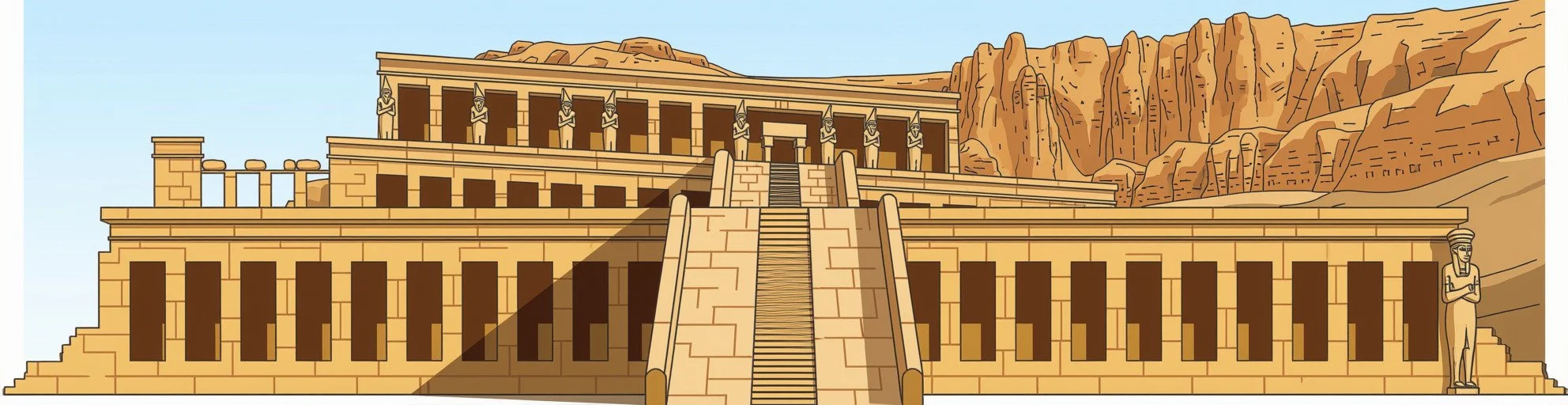
Illustration: Temple of Hatshepsut - Deir El-Bahari
Research tracing Hatshepsut-related artifacts between Egypt, Berlin, and New York therefore raises questions beyond transfer and ownership. At each stage of movement, the artifact acquires new classifications, institutional histories, conservation records, and cultural value. It may also lose sacred purpose, spatial relationship, local memory, and the authority of those closest to the place from which it came. The museum does not simply receive Hatshepsut. It remakes Hatshepsut through the categories available to it. The historical figure who once articulated power through architecture, divine legitimacy, ceremony, and political representation is dispersed across institutions and reassembled through fragments. An artifact removed by force and not by eco-social compliance.
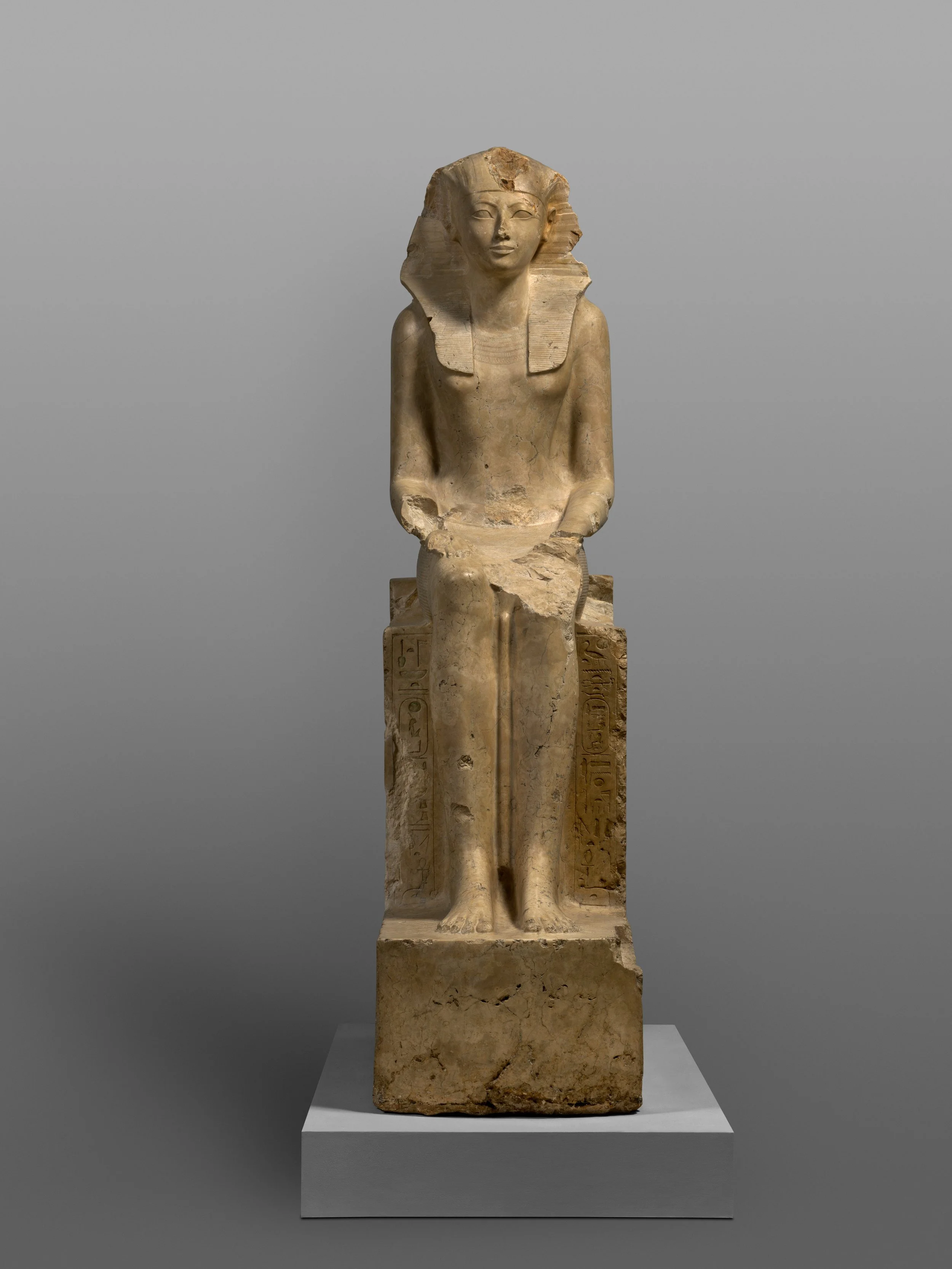
Seated Statue of Hatshepsut, New Kingdom, ca. 1473–1458 BCE.
The Met Collection, New York.
An eco-social approach to criticism must take this geography seriously. Land cannot be treated as a picturesque background to the artwork. It is an active participant in meaning. The environmental conditions of a site, the movement through it, the relation between monument and horizon, and the communities living around it contribute to how cultural knowledge is formed. Criticism that ignores these relations risks reproducing the same abstraction through which museum systems detach cultural entities from the worlds that shaped them.
The work of Egyptologist Kerylos Aziz, a member of BLACK LAND since 2021, is significant in this regard. His practice is rooted in long-term engagement with archaeological sites across Egypt and in the pursuit of perspectives beyond the most institutionalized narratives of ancient history. This position foregrounds proximity as a form of knowledge. The person who repeatedly walks a site understands scale, distance, heat, direction, sound, and movement in ways that cannot be fully translated into an exhibition catalogue. Communities surrounding archaeological sites also possess lived relationships, memories, and interpretations that academic and museum structures may fail to recognize.
To value these perspectives is not to reject scholarship or scientific rigor. It is to challenge the narrow definition of where rigor may be found. New art criticism must be capable of recognizing that the archive is not only textual, and that knowledge may be carried through landscape, ceremony, oral history, movement, memory, and repeated encounter. In this expanded sense, eco-social writing becomes a practice of connecting knowledge systems rather than ranking them.
BLACK LAND’s commemoration of the person catalogued as ÄM 53 reveals the ethical urgency of this expansion. An inventory number is designed to make institutional holdings manageable. Yet when applied to a human body, it exposes the distance between administrative order and human recognition. The person believed to have been an ancient Egyptian priest becomes legible to the museum, and at the same moment, his name, spiritual identity, and relationship to death become less visible.
This is not simply a problem of insensitive language. It concerns the transformation of a person into a research object and the separation of human remains from the beliefs, rituals, and communities surrounding burial. Within ancient Egyptian cosmology, the preservation of the name, body, and ritual context was inseparable from the continuation of life beyond death. Exhumation therefore did not merely disturb a grave; it interfered with an entire system of relation. Moradi’s writing shows how the colonial collection of art was frequently connected to the collection, numbering, storage, and study of human remains, making the separation between cultural object and human body part of the institutional order created by colonial knowledge.
The act of commemoration resists this order by returning attention to the person obscured by classification. It asks whether an institution that knows where a body is stored also knows how to mourn, and whether care is possible without confronting the conditions through which the dead became available for possession. Art criticism engaging with such work must therefore move beyond description. It must consider the ethical implications of spectatorship and ask what it means to write about a body whose presence in the institution may itself be the continuation of an unresolved violation.
Egyptologist Monica Hanna’s contribution to BLACK LAND, RED LAND—RESTITUTE brings this ethical question directly into the continuing history of Nefertiti. During the festival, Hanna presented her long-standing research into the bust’s provenance and the preparations surrounding its possible return, placing the familiar image of the queen within a history that exceeds its status as one of Berlin’s most recognizable museum attractions. Nefertiti’s extraordinary visibility has not dissolved the conditions of her displacement; rather, her fame demonstrates how thoroughly an ancient Egyptian presence can be absorbed into another nation’s cultural identity, tourism economy, and institutional prestige. The bust is widely accessible as an image, yet the authority to determine its physical location, interpretive setting, and political future remains concentrated elsewhere. Hanna’s intervention consequently shifts the discussion from whether Nefertiti is universally admired to who has inherited the power to decide what that admiration permits.
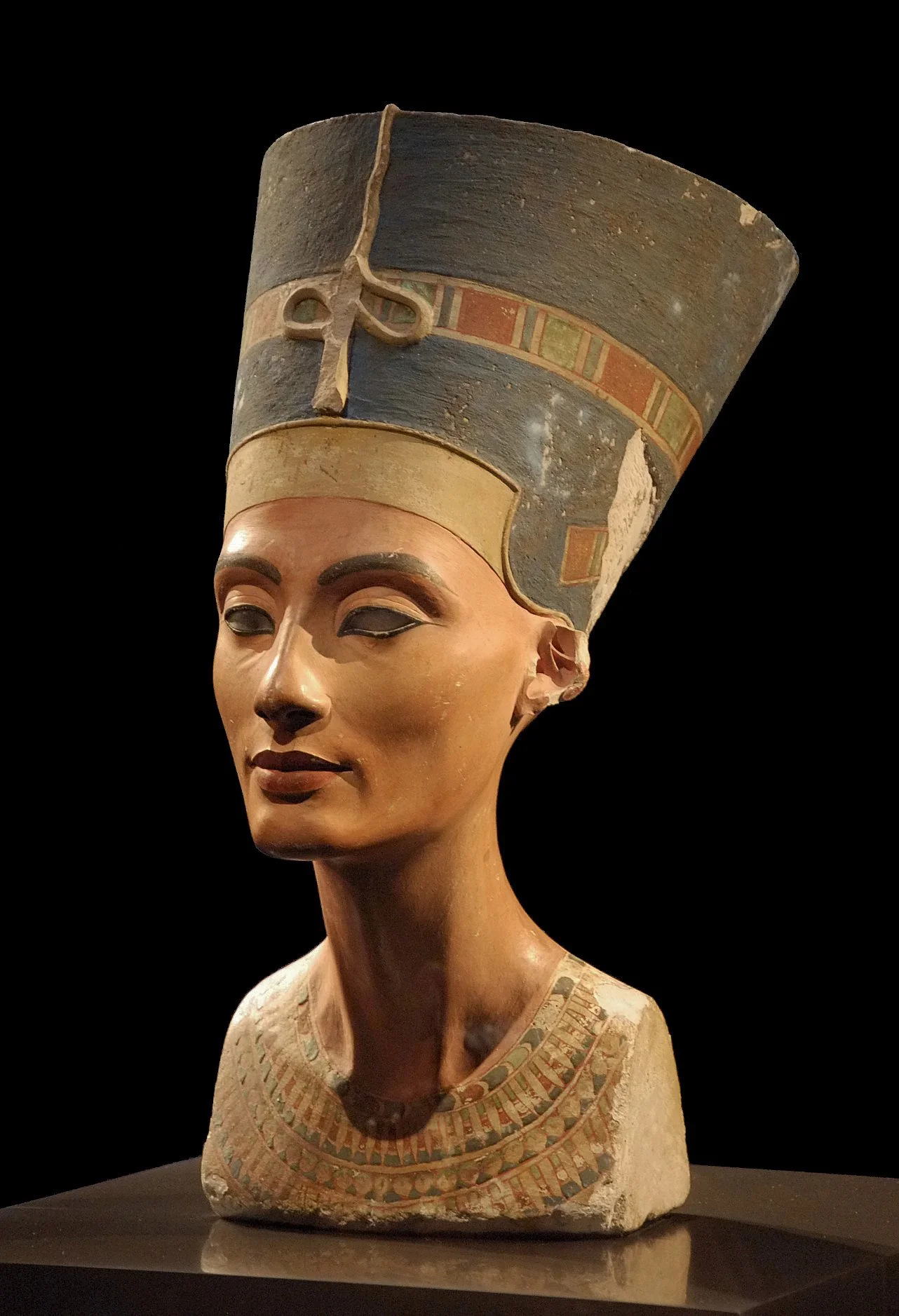
The bust of Nefertiti, 1345 BC. Neues Museum, Berlin, Germany.
Hanna’s wider scholarship emphasizes the relationship between archaeological heritage, public access, identity, and the communities connected to the places from which cultural material emerges. Her work on decolonizing and democratizing archaeology challenges the assumption that expertise belongs principally to museums and specialist institutions, proposing instead that archaeology must remain socially accountable and available to a broader public. From an eco-social critical perspective, this position restores the relationship between the artifact and the spatial, cultural, and living environment from which it has been separated. Nefertiti is not only an exceptional artwork or an object of diplomatic dispute; she is part of an Egyptian historical landscape whose meanings cannot be wholly transferred with the artifact into a European gallery. Criticism must therefore examine not only the conditions of acquisition and display, but also the unequal distribution of cultural access: who may encounter the material inheritance of a place, who benefits from its international visibility, and who retains the authority to decide whether it can return.
Restitution is often presented as the point at which this history may be repaired. The process appears orderly: identify the object, establish provenance, determine ownership, negotiate return, and announce transfer. Yet Moradi’s argument demonstrates that restitution cannot be understood as a clean conclusion when the systems governing return are often the same systems that authorized possession. The institution may act as holder, interpreter, negotiator, and final arbiter. The former imperial state determines whether the conditions for return have been satisfied, and even the language of generosity may preserve hierarchy. An object is “given back,” as though the current holder possesses the natural authority to grant it. A loan may allow a community temporary access to what was removed from it.
The grammar of restitution can therefore reveal the survival of colonial relations within contemporary policy. BLACK LAND’s work suggests that return must be understood not merely as a transfer of matter but as a transformation of authority, access, interpretation, and responsibility. Legal and material return remain essential, but they cannot restore a destroyed city, reconstruct a murdered knowledge system, or make an exhumed grave untouched. A revised label cannot reverse centuries of institutional power. A public ceremony cannot on its own repair the relations broken by removal, and the power of spelling still lives in the one who speaks the word into meaning.
Moradi’s concept of catastrophic art keeps this remainder open. It resists the comfort of believing that a historical wound has been resolved because an object has crossed a border. Catastrophic art continues to carry the fracture, even after restitution, because the world to which it returns may also have been transformed by the catastrophe. Responsibility must therefore continue beyond the moment of return.
This is where the challenge of new critical writing becomes most visible. Criticism has often been expected to clarify, evaluate, and conclude. Eco-socially engaged practice frequently refuses such closure. It presents histories that cannot be neatly reconciled, communities whose demands may not align, and harms that cannot be fully repaired. The role of the critic is not to manufacture resolution where none exists. Instead, it may be to keep the conflict ethically visible, identify the systems that benefit from simplification, and preserve the complexity of relations that institutions seek to make manageable.
BLACK LAND’s interdisciplinary methods support this expanded critical practice. Performance makes the body a site of historical inquiry. Sound shifts attention away from the authority of sight. Ritual opens a space for relation without reducing the sacred to illustration. Curatorial research follows the movement of artifacts while questioning the categories that govern it. Public discussion brings institutional language into contact with artistic, legal, historical, and community-based perspectives. None of these forms provides a final answer. Together, they produce a critical environment in which knowledge can remain multiple.
The openness of the congress on art criticism and eco-socially engaged practices to readings, performances, and action-oriented lectures reflects this same need for expanded forms. The traditional academic paper may not always be sufficient for practices that operate through embodiment, atmosphere, collective action, and spatial encounter. New criticism may need to be performed, listened to, walked through, or produced collaboratively. It may need to acknowledge that language itself has limits when addressing colonial destruction, ecological loss, sacred relation, and historical trauma.
This does not diminish writing. It makes writing more responsible. The critical text becomes one element within a larger ecology of response rather than the final authority on the work. It can connect historical research with artistic experience, institutional critique with local knowledge, and aesthetic analysis with social responsibility. It can reveal what has been obscured without claiming to recover everything that was lost.
The displaced artifact is not passive within this process. It does not simply wait for critics, curators, governments, or museums to determine its meaning. Its presence already disturbs the structures around it. It brings the site of removal into the gallery, the violence of acquisition into the catalogue, and the absent community into the institution. It carries the histories the museum may struggle to contain. This is why the artifact cannot be reduced to evidence of a magnificent past. It also speaks to the political conditions of the present: who may move freely, who remains contained, whose knowledge is authoritative, whose heritage is accessible, and whose loss has been converted into another institution’s cultural wealth.
The museum may believe it holds the artifact, but the artifact also holds the museum within its history. It records the laws, narratives, and economies built around its possession. It reveals the systems that normalized displacement. It asks the museum to confront not only where the work came from but what the institution became by keeping it.
BLACK LAND listens to this confrontation. It does not attempt to recover an untouched past, nor does it use ritual as a substitute for political and legal responsibility. Instead, it creates spaces in which cultural entities can exceed their institutional classification. Sound moves beyond the glass, the replica challenges the authority of the original, the inventory number is drawn back toward a human name, and the archaeological site enters the museum as an absent yet active presence.
Through this work, criticism is asked to change as well. It must become less concerned with mastering the artifact and more attentive to the relationships surrounding it. It must ask not only what a work means, but what forms of life, knowledge, and environment have been obscured in order for that meaning to appear stable. It must be willing to examine its own vocabulary and to recognize when terms such as collection, heritage, preservation, access, and restitution conceal unequal relations.
A new eco-social criticism would therefore be historical without treating history as closed, aesthetic without isolating form from power, and political without reducing art to illustration. It would understand that ecological questions include not only threatened environments but the destruction of relationships between land, memory, body, and knowledge. It would recognize colonialism as both a social and ecological rupture, one that reordered territories, extracted materials, displaced communities, and converted living worlds into resources.
Such criticism would also resist speaking on behalf of those whose voices have already been displaced. It would create space for multiple forms of knowledge and make its own limitations visible. It would not assume that the critic’s interpretation completes the work. Instead, it would approach writing as an ethical encounter: a practice of attention, responsibility, and relation.
Return may begin within this change of orientation. It may begin when the institution relinquishes its certainty, when provenance accounts for the violence before the first recorded owner, when local and embodied knowledge is treated as intellectually authoritative, and when a sacred entity is no longer understood only as material. It may begin when access means more than entry into a museum and when the archive recognizes what it excluded.
The most important question is therefore not simply whether the artifact should remain or return. It is what must change in the museum, in criticism, and in the structures of cultural authority before return can become meaningful. BLACK LAND’s work offers no comfortable resolution, but it creates the conditions for a more honest encounter. The museum may preserve the stone, regulate the room, secure the glass, and publish the catalogue, but it cannot hold the whole story. The responsibility of new art criticism is to ensure that the story is no longer reduced to what the museum is prepared to contain.
The essay centers on BLACK LAND’s interdisciplinary festival, presented in Berlin from December 21–28, 2023, across silent green Kulturquartier, Kunstquartier Bethanien, Palais am Festungsgraben, and public space, while tracing the initiative’s continued research and performances through the Kunstbau at Lenbachhaus in Munich, the Ritual Festival in Cologne, Pratt Institute in New York, and Museum Tinguely in Basel during 2025.
Bibliography
BLACK LAND e.V. 2022. “BLACK LAND 2022.” BLACK LAND.
BLACK LAND e.V. 2023. “ÄM 53.” BLACK LAND.
BLACK LAND e.V. 2023. “BLACK LAND, RED LAND—RESTITUTE.” Interdisciplinary festival program, Berlin, December 21–28, 2023.
BLACK LAND e.V. 2023. “Dedication to Sakhmet.” In BLACK LAND, RED LAND—RESTITUTE.
BLACK LAND e.V. 2023. “Names of Sakhmet.” BLACK LAND.
BLACK LAND e.V. 2025. “Upcoming Events and Research.” BLACK LAND.
Irwin, Michael. 2023. “BLACK LAND Festival to Honour Egyptian Goddess in Berlin.” Ocula Magazine, December 15, 2023.
Moradi, Fazil. 2022. “Catastrophic Art.” Public Culture 34 (2): 243–264. Duke University Press. https://doi.org/10.1215/08992363-9584750.
Pratt Institute. 2025. “2025 AICAD Symposium: Engaging Values.” Symposium program, November 12–14, 2025.
Sinanina, Elena. 2023. “Es gibt keine offene und freie Diskussion zu diesem Thema” [“There Is No Open and Free Discussion on This Subject”]. Interview by Silke Hohmann. Monopol, December 20, 2023.