

The Small Doorways of the Mind: Reading Malcolm Gladwell and the Hidden Architecture of Human Behavior
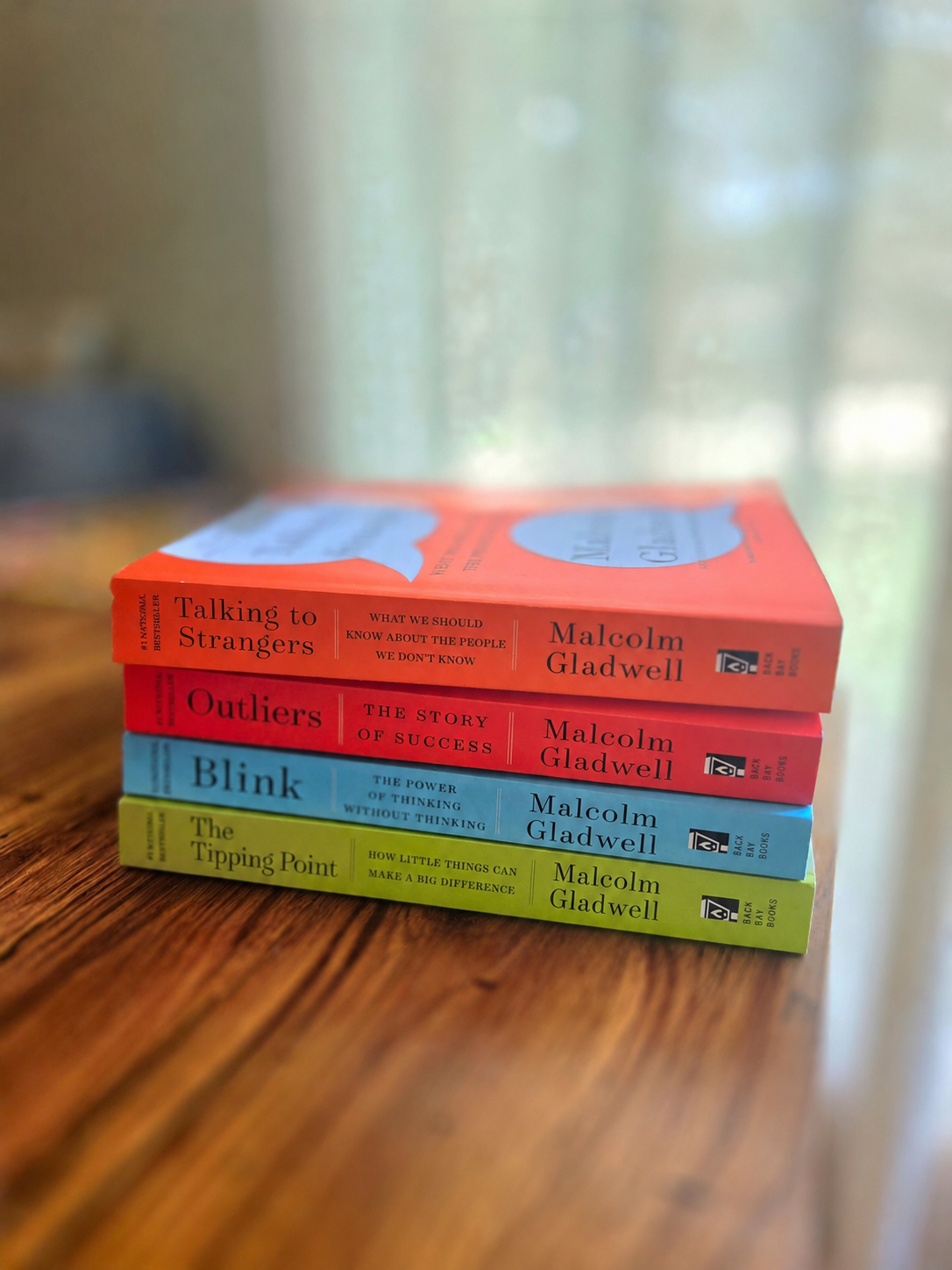
Desk view of the Gladwell Books. Special Thanks to John K. for the recommendation.
There are writers who hand us answers, and then there are writers who hand us a door.
Malcolm Gladwell belongs to the second kind. His books do not simply explain the world; they rearrange the furniture inside it. A statue becomes a crime scene. A marriage becomes a weather system. A stranger on the side of the road becomes a national wound. A hockey roster becomes a map of invisible privilege. A pair of shoes, a rumor, a gesture, a glance—under Gladwell’s gaze, the ordinary begins to tremble with meaning.
This is the strange pleasure of reading him. He begins with something small, almost forgettable, and then asks us to stand still long enough to see the machinery behind it. Why did one idea spread and another vanish? Why did one person succeed while another, equally gifted, disappear into the crowd? Why do we trust the wrong people, misread the innocent, overvalue confidence, and mistake appearances for truth? Why do our minds, so dazzling and so ancient, sometimes know before they know—and sometimes fail us at the exact moment we need them most?
Gladwell’s work lives in that uneasy space between instinct and evidence, between the story we tell ourselves and the story the world is quietly telling beneath the surface. His great subject is not success, or popularity, or judgment, or strangers. His great subject is the hidden force: the unseen current beneath visible events.
In Blink, he enters through the side door of the mind. The book is built around the idea that our brains can make decisions in an instant, long before language arrives to dress them up in logic. Gladwell calls our attention to rapid cognition: the small, private lightning of the adaptive unconscious. This is the part of us that reads a room before we introduce ourselves to it, senses danger before we can explain it, recognizes beauty or fraud or tension before the slow machinery of analysis has even begun to turn.
He calls this “thin-slicing,” the human ability to take a narrow sliver of experience and form a judgment from it. In the hands of an expert, thin-slicing can be astonishing. An antiquities specialist looks at a statue and feels, almost physically, that something is wrong. A psychologist watches a couple speak for a few minutes and hears the future cracking in the rhythm of their contempt. A seasoned professional can separate signal from noise, knowing which details matter and which are merely performative.
This is one of Gladwell’s most seductive ideas: that wisdom is not always loud, linear, or slow. Sometimes it is immediate. Sometimes it arrives as a bodily shiver. Sometimes the mind, trained over years, can leap across a canyon that reason would spend hours building a bridge over.
But Blink is not a love letter to intuition. It is more complicated and more useful than that. Gladwell is interested in the brilliance of snap judgment as well as its shadow. The same unconscious that can detect a forgery can also manufacture prejudice. The same quickness that saves us can condemn someone else. The same first impression that feels like certainty may only be bias wearing the mask of instinct.
This is where his work becomes more than clever. Gladwell asks us to treat the mind not as a flawless oracle but as a powerful instrument that must be tuned. Stress can distort perception. Fear can shrink the world into a tunnel. Too much information can become fog rather than clarity.
Under pressure, the mind can confuse a wallet for a weapon, confidence for competence, beauty for leadership, familiarity for truth.
In the story of Amadou Diallo, Blink turns from elegant psychology to tragedy. Rapid cognition, stripped of time and poisoned by fear, becomes fatal. Gladwell does not let us keep intuition as a romantic concept. He forces us to look at the cost of misreading. A glance is never just a glance when power is attached to it.
From there, Talking to Strangers expands the question. If Blink asks how we judge in an instant, Talking to Strangers asks why we are so often wrong when we believe we are being reasonable. The book circles around a painful human truth: we think other people are more transparent than they are. We believe faces reveal souls. We believe tone reveals intention. We believe nervousness means guilt, eye contact means honesty, calmness means innocence, and a good story means a good person.
Gladwell troubles all of that.
He shows us that strangers are not open books. They are locked rooms with windows painted on the walls. We look through those painted windows and mistake them for a way in. We believe we are seeing inside when we are often only seeing performance, culture, fear, trauma, etiquette, confusion, or the limits of our own imagination.
One of the most powerful ideas in Talking to Strangers is the human tendency to “default to truth.” We are built, socially and practically, to believe one another. Society would collapse if every conversation began as a cross-examination. Trust is not a weakness; it is the lubricant of civilization. It allows contracts, friendships, classrooms, marriages, markets, and ordinary daily life to function.
But trust has a dark corridor. It can be exploited by the Bernie Madoffs of the world. It can blind institutions. It can allow fraud to wear a tailored suit and walk through the front door. It can also create terrible encounters when suspicion appears in the wrong place, at the wrong time, with the wrong person.
Here again, Gladwell refuses simplicity. He is not telling us to trust less, nor is he telling us to trust more. He is asking us to understand the conditions under which trust fails. He is asking us to become more humble in the face of other people’s interior lives. The stranger is not a puzzle we solve by staring harder. The stranger is a context we must learn to approach with care.
That word—context—may be the hidden key to all of Gladwell’s work.
In Outliers, he takes the most beloved myth in modern culture, the myth of the self-made genius, and begins to loosen its seams. Success, he argues, is not simply the flower of talent. It is the soil, the weather, the season, the gardener, the fence, the accident of where the seed happened to fall.
The outlier does not stand outside the world. The outlier is produced by the world.
This is why Gladwell’s stories about success feel both thrilling and unsettling. Bill Gates is brilliant, yes—but brilliance alone is not the whole story. The Beatles were extraordinary, yes—but their hours in Hamburg mattered. Hockey players born early in the year did not simply possess more destiny in their bones; they benefited from the quiet mathematics of age cutoffs, size, selection, coaching, reinforcement, and accumulated advantage.
This is the Matthew Effect in human form: advantage attracts more advantage. A small head start becomes better training. Better training leads to more confidence. More confidence means more opportunity. Opportunity becomes excellence. Excellence then looks, from a distance, like fate.
Gladwell’s gift is to shorten that distance. He walks us backward from the shining outcome to the hidden arrangement that made it possible. He asks us to look not only at the champion on the podium, but at the birthday, the school, the mentor, the timing, the family, the culture, the accident, and the door that happened to be unlocked.
And this is where his work carries an ethical charge. To understand success as contextual is not to diminish achievement. It is to tell the truth about it. It is to say that talent matters, but talent needs a stage. Effort matters, but effort needs access. Genius matters, but genius still needs time, tools, permission, and proximity.
In The Tipping Point, Gladwell turns from individual lives to social motion. Here, ideas behave like weather systems. Trends gather pressure. Behaviors spread. A small, precisely placed push can alter the course of a crowd. The world does not always change by thunderclap. Sometimes it changes by whisper, by network, by repetition, by one person telling two people who tell ten more.
The “tipping point” is that magical, dangerous threshold where accumulation becomes eruption. A product, a rumor, a disease, a fashion, a social behavior—each may appear sudden, but Gladwell teaches us to distrust suddenness. What looks like overnight success is often the visible crest of an invisible wave.
Across these books, one begins to hear the same deep music. Gladwell is asking us to pay closer attention to beginnings. Not grand beginnings, but small ones: the first impression, the early advantage, the narrow context, the hidden assumption, the overlooked connector, the tiny environmental cue. He believes the world is shaped by forces we routinely underestimate because they do not announce themselves dramatically.
His books are not merely about psychology or sociology. They are about humility.
They remind us that the mind is powerful, but partial. That talent is real, but never alone. That strangers deserve more caution than our assumptions allow. That data can illuminate, but also drown. That intuition can be wisdom, but also inheritance, bias, fear, and training, speaking in the same voice. That success is rarely a solo performance. That a culture can live inside a cockpit, a classroom, a boardroom, a police stop, a marriage, a marketplace, a nation.
To read Gladwell is to become suspicious of the obvious. It is to pause before the easy explanation. It is to ask: What else is here? What have I missed? What condition made this outcome possible? What story is hiding behind the story?
Perhaps that is why his books endure. They do not simply give readers information; they alter the reader’s posture. You begin one of his books standing upright in certainty. You leave slightly bent forward, peering under the surface of things.
And that is the invitation.
Read Blink if you want to understand the strange electricity of first impressions, and why the mind can be both brilliant and dangerous in the space of two seconds.
Read Talking to Strangers if you want to sit with the difficulty of human misunderstanding, and learn why people are never as transparent as we want them to be.
Read Outliers if you want to reconsider success—not as a lone mountain climbed by the gifted few, but as a landscape shaped by time, culture, access, luck, labor, and legacy.
Read The Tipping Point if you want to understand how little things gather force, how movements begin, and why the smallest shift can sometimes open the largest door.
Together, these books form a kind of atlas. Not of countries, but of hidden systems. They map the invisible: instinct, bias, trust, opportunity, contagion, advantage, context. They remind us that human behavior is rarely random, even when it looks mysterious. Beneath the surface, there is a pattern. Beneath the pattern, there is a story. Beneath the story, a question waits patiently to be asked.
And Gladwell, at his best, teaches us how to ask it.
Buy Blink.
Buy Talking to Strangers.
Buy Outliers.
Buy The Tipping Point.
References
Malcolm Gladwell’s official author site lists his major books, including Blink, Talking to Strangers, Outliers, The Tipping Point, The Bomber Mafia, and Revenge of the Tipping Point, and identifies him as a bestselling author, podcast host, and cofounder of Pushkin Industries. (Malcolm Gladwell)
Hachette’s official page for Blink describes the book as a work on leadership and decision-making, centered on choices made “in the blink of an eye,” including case studies such as the Getty kouros, John Gottman’s marriage research, Warren Harding, New Coke, and Amadou Diallo. (Malcolm Gladwell)
Hachette’s official page for Talking to Strangers describes the book as an examination of interactions with people we do not know, including cases involving Fidel Castro, Neville Chamberlain, Bernie Madoff, Amanda Knox, Sylvia Plath, Jerry Sandusky, and Sandra Bland. (Malcolm Gladwell)
Hachette’s official page for Outliers presents the book as an exploration of what sets high achievers apart, emphasizing culture, family, generation, upbringing, and case studies involving Bill Gates, the Beatles, sports, and cultural patterns. (Hachette Book Group)
Hachette’s official page for The Tipping Point defines the tipping point as the moment when an idea, trend, or social behavior crosses a threshold and spreads, framing the book around viral trends in business, marketing, psychology, and human behavior. (Malcolm Gladwell)
© 2026 Aïda Eltorie / Oggi Collective Agency. All rights reserved.